

If you’ve ever pitched the idea of branded merch or swag to your leadership, you’ve probably heard some version of this question: “How many sales is this actually going to bring in?”
Unlike digital campaigns, promotional products don’t come with a dashboard full of clicks and conversions. A branded hoodie doesn’t guarantee a lead the moment someone puts it on. A logoed water bottle doesn’t send you a notification every time someone takes a sip.
But that doesn’t mean promotional products aren’t driving revenue – that impact just happens differently. Here’s how to answer the ROI question and prove the value of your swag efforts.
Look Beyond The Funnel
The first step in answering the ROI question is understanding how customers actually buy. We know that most sales don’t happen because of one single marketing touchpoint.
Customers might see a LinkedIn ad, then…
↳ receive a piece of swag at a trade show, which prompts them to…
↳ visit your website, where they decide to…
↳ attend a webinar, after which they finally…
↳ talk to a salesperson, and eventually…
↳ make a purchase decision!
Which one gets credit? Usually, it’s the last touchpoint – or at least, whichever one has tracking metrics built in. But real customers don’t make buying decisions that way.
Promotional products are rarely the final touchpoint before a sale, but they’re often one of the most memorable. A useful giveaway keeps your brand in front of prospects long after an event ends, helping create familiarity and trust that can influence future decisions.
Measure the Right Things
Just because promotional products don’t fit neatly into an analytics dashboard doesn’t mean you need to abandon KPIs altogether. The key is matching your metrics to your campaign goals.
Metric | How It’s Measured | Why It Matters | Example |
Cost per Impression | Total campaign cost ÷ estimated product impressions | Shows long-term value compared to other advertising channels | A $10 tumbler used 200 times delivers a $0.05 cost per impression. |
Campaign Engagement | QR code scans, landing page visits, promo code redemptions | Connects merchandise to measurable customer actions | 35% of event attendees scanned the QR code on a keychain giveaway. |
Product Adoption | Surveys, observations, social posts, repeat use | Indicates whether recipients actually use and value the product | Recipients share photos unboxing their 3DDM kit. |
Sales Influence | Review closed opportunities for campaign participation | Demonstrates where promotional products supported the buying journey | 40% of new customers were included on a mailing campaign before eventually becoming a client. |
Brand Recall | Post-event or customer surveys | Measures awareness and memorability | 72% of attendees report on survey that they recall your brand one month after the event. |
No single metric tells the whole story, and that’s okay. Promotional products rarely create instant revenue on their own. Instead, they contribute to awareness, engagement, and trust, all of which help move prospects closer to a purchase. Remember: ROI doesn’t end when someone picks up your swag. In fact, that’s usually where it begins.
Numbers Tell the Story
If your leadership team still needs proof that promotional products are more than just “free stuff,” the research is on your side.
The 2026 ASI Ad Impressions Study found that promotional products remain one of the most cost-effective forms of advertising. The study also found that usefulness drives ROI. Nearly 80% of U.S. consumers say they keep promotional products because they’re useful, meaning the right item can continue building brand awareness long after it’s handed out.
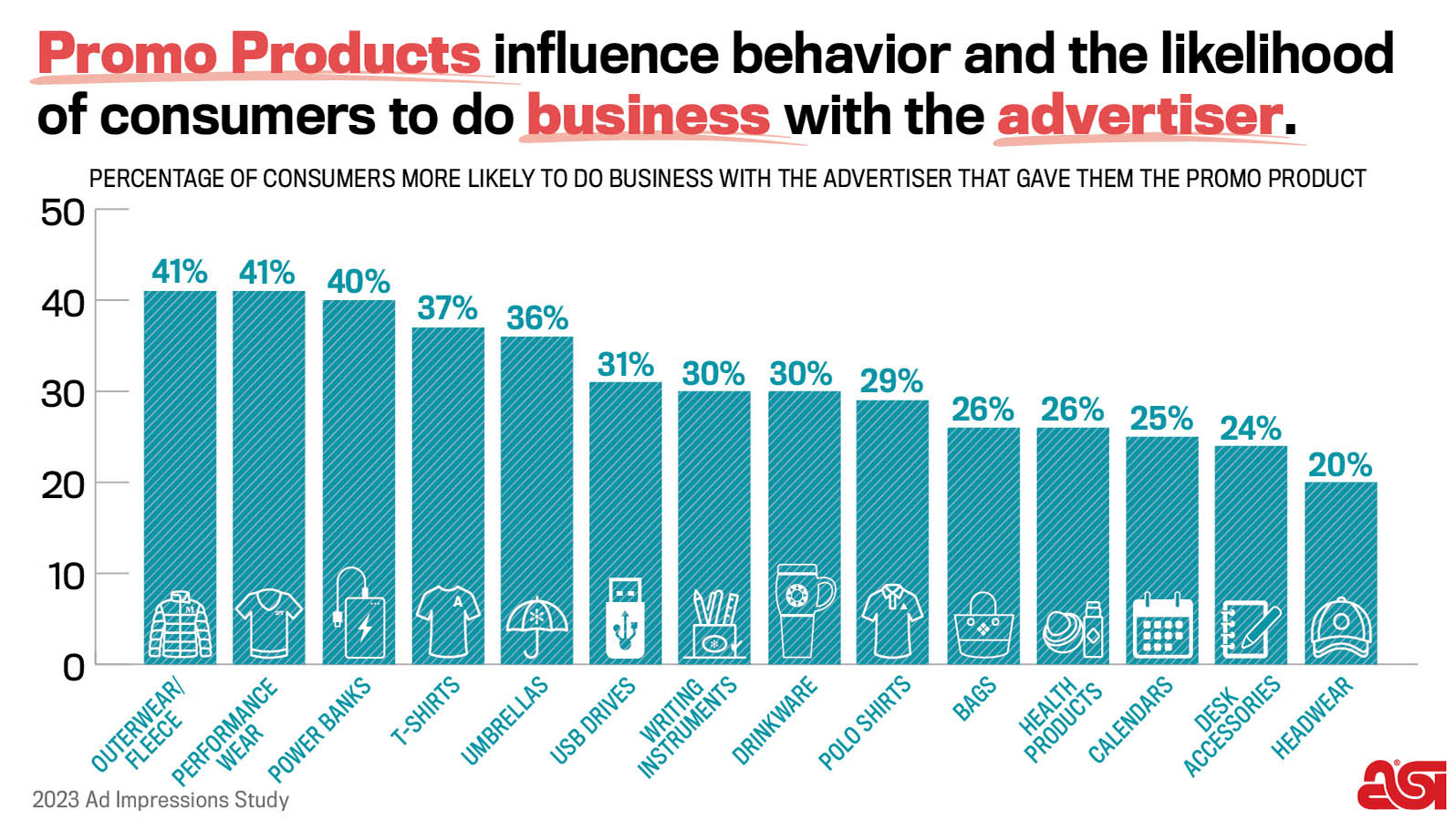
And perhaps most importantly, promotional products influence how people feel about your brand. Again, nearly 80% of consumers say they have a more favorable impression of a company after receiving branded merchandise, and three in four say they’re more likely to do business with that company. In fact, consumers ranked promotional products as their preferred form of advertising over television, social media, radio, and online ads.
So when leadership asks, “How many sales did this generate?” the answer isn’t always a single number – because a branded tumbler probably won’t close a deal by itself. But when those products keep your brand visible, spark conversations, and create positive experiences with your customers, they become part of the reason people remember you when it’s time to buy.
That’s the power of great swag: it puts your brand into real life.
Ready to make some merch people actually want? Say “hey” to our team and we’ll help you bring your brand to life.
